
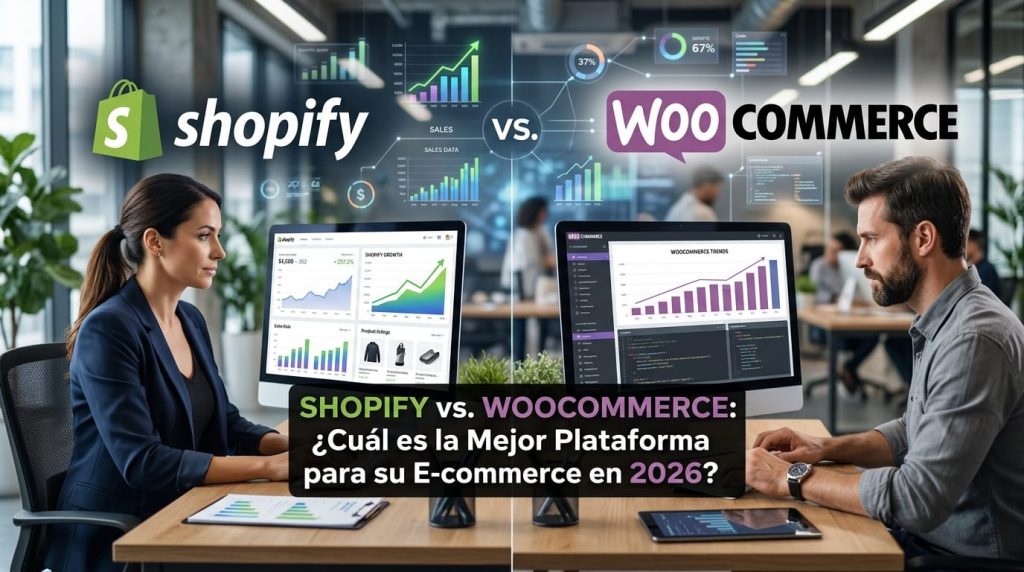
The decision to launch or migrate an online store is one of the most crucial for any business in the digital ecosystem. In this arena, two giants vie for leadership: Shopify and WooCommerce. Both platforms offer robust solutions for e-commerce, but each with a distinct philosophy, set of functionalities, and management model. The key question is not which is superior in abstract, but which is best for your specific business in 2026.
At adrianalcala.es, we understand that choosing the right platform is the first step towards successful e-commerce. This article will break down the features, advantages, and disadvantages of Shopify and WooCommerce, helping you make an informed decision that drives your growth and maximizes your digital investment.
1. Shopify: The Simplified All-in-One Solution
Shopify es una plataforma de e-commerce “todo-en-uno” basada en la nube, conocida por su facilidad de uso y su enfoque en simplificar la venta online para emprendedores y empresas de todos los tamaños. No requiere conocimientos técnicos profundos para empezar.
Advantages of Shopify:
- Ease of Use: Su interfaz intuitiva permite configurar una tienda rápidamente, añadir productos, gestionar pedidos y procesar pagos sin necesidad de programar. Es ideal para quienes buscan una solución “plug-and-play”.
- Hosting and Security Included: Shopify handles hosting, security (SSL certificates), updates, and maintenance. This frees the merchant from technical concerns.
- Robust Customer Support: It offers 24/7 support, which is invaluable for quickly resolving issues, especially for new merchants.
- Scalability: Although easy to start, Shopify can scale to handle large sales volumes and grow with your business.
- Apps and Themes: It has an extensive app market (App Store) to add functionalities and a wide range of themes (free and paid) to customize the design.
Disadvantages of Shopify:
- Monthly Cost and Fees: Shopify operates on a monthly subscription model. Additionally, if you don't use Shopify Payments, transaction fees apply. These costs can add up as the business grows.
- Limited Flexibility: Although customizable with apps and themes, it has less flexibility in code-level customization and data management compared to open-source solutions.
- Platform Dependence: Al ser una solución SaaS, usted no “posee” la plataforma, lo que implica cierta dependencia de las políticas y funcionalidades de Shopify.
2. WooCommerce: Open-Source Power and Flexibility with WordPress
WooCommerce is an open-source plugin for WordPress that transforms it into a robust e-commerce platform. It requires an existing WordPress installation and offers almost unlimited control over the store.
WooCommerce Advantages:
- Total Control and Flexibility: Being open-source and running on your own hosting, WooCommerce offers you absolute control over every aspect of your store, from design to functionality and data. It's ideal for those who want deep customization.
- Low Initial Cost (Potentially): The WooCommerce plugin is free. Costs are derived from web hosting, domain, themes, and other premium plugins. It can be more economical in the long run for certain configurations.
- WordPress Ecosystem: You benefit from the vast WordPress community, its thousands of themes and plugins, and familiarity with its CMS for content management (blog, pages).
- Powerful SEO: Thanks to its integration with WordPress and plugins like Yoast SEO or Rank Math, WooCommerce offers very powerful and customizable SEO tools.
WooCommerce Disadvantages:
- Learning Curve: Requires more technical knowledge for initial setup, maintenance (updates, security), and troubleshooting. You are responsible for hosting and security.
- Hidden Costs: Although the plugin is free, costs for hosting, security, premium themes, additional plugins, and technical support can add up and sometimes exceed Shopify's cost.
- Performance: The speed and performance of the store depend heavily on the quality of hosting and correct technical optimization. A poorly optimized site can be slow.
- Fragmented Support: Support comes from the WordPress community, plugin developers, or your hosting provider, which can be less direct than Shopify's unified support.
3. Shopify vs. WooCommerce: Which to Choose in 2026?
The ideal choice depends on your business's specific needs and priorities:
- Choose Shopify if:
- You need a quick and easy solution to start selling online.
- You don't have technical knowledge or prefer not to handle maintenance and security.
- Valora el soporte técnico 24/7 y una experiencia “todo incluido”.
- You are willing to pay a monthly fee and potential commissions for convenience and service.
- Choose WooCommerce if:
- You desire complete control and unlimited customization over your store.
- You already have a WordPress site and are familiar with its ecosystem.
- You have technical knowledge or a team that can manage hosting, security, and maintenance.
- You want to maximize flexibility and minimize long-term recurring costs, assuming greater technical responsibility.
- You need very specific integrations or functionalities that require deep code access.
Conclusion: Strategy is the Core, the Platform is the Vehicle
Both Shopify and WooCommerce are exceptional tools that, in 2026, continue to evolve to offer cutting-edge solutions. The final decision is not based on intrinsic superiority but on alignment with your business strategy, budget, technical resources, and long-term goals. Consider your management capacity, the importance of customization, and the scale of your project.
In adrianalcala.es, we are experts in e-commerce implementation and optimization, whether you choose the managed simplicity of Shopify or the robust flexibility of WooCommerce. We help you analyze your needs, select the ideal platform, and build an online store that not only sells but grow and prosper.
Ready to take the leap into e-commerce with the perfect platform for you? Contact us today and let's design your online success strategy together.