
Si alguna vez has pagado anuncios y has mandado los clics a la portada de tu web, probablemente has visto el resultado: muchas visitas, pocos contactos. La razón suele ser la página, no el anuncio. En esta guía verás qué es una landing page, en qué se diferencia de tu página de inicio, qué partes la hacen funcionar y cuándo merece la pena tener una.
The essentials in 30 seconds
- Una landing page es una página con un solo objetivo: que quien llega te escriba, te compre o reserve.
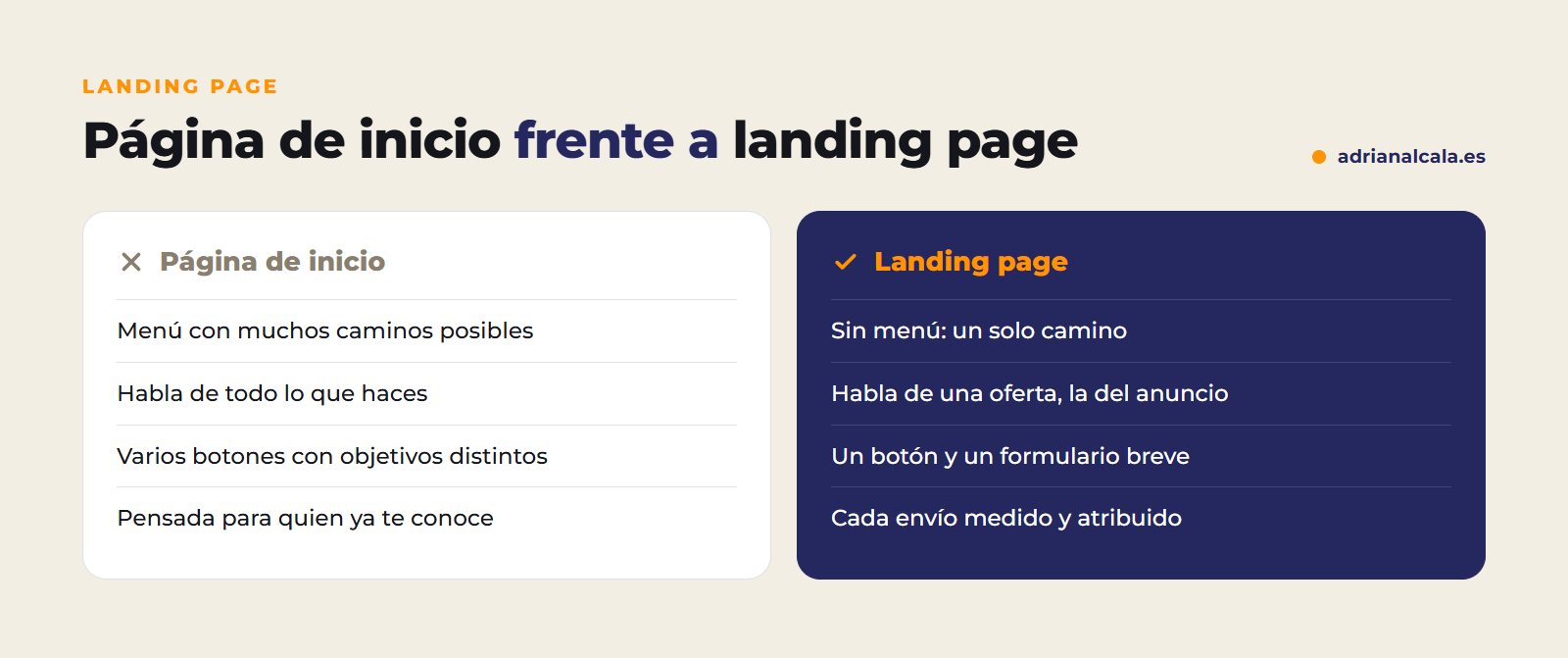
- No tiene menú ni caminos alternativos: una oferta, un botón, un formulario.
- El anuncio y la página deben decir the same: otherwise, the visit leaves and the campaign becomes more expensive.
- Without measured conversions, you don't know which campaign brings customers.
In this article
What is a landing page
Landing page literally means «landing page»: it's the page someone arrives at after clicking on an ad, an email, or a post. But what defines it is not how you get there, but what it's made for: achieve a single specific action.
A homepage has to present your entire business to anyone who arrives. A landing page talks about a single offer, to a specific type of person, and everything it contains pushes towards the same decision.
Landing, service page and homepage
| Page type | What it's for | Where the visit comes from |
|---|---|---|
| Homepage | Present the business and distribute to the other pages | Whoever searches for your name or enters directly |
| Service page | Explain a service and appear on Google for it | Google searches and internal links |
| Landing page | Achieve a specific action from a campaign | Ads, emails, social media |
When you need a landing page
A close example: the page of the Academy waiting list is a landing. It has a single objective, to sign up, and everything on it explains why to do it.
The parts of a landing that converts
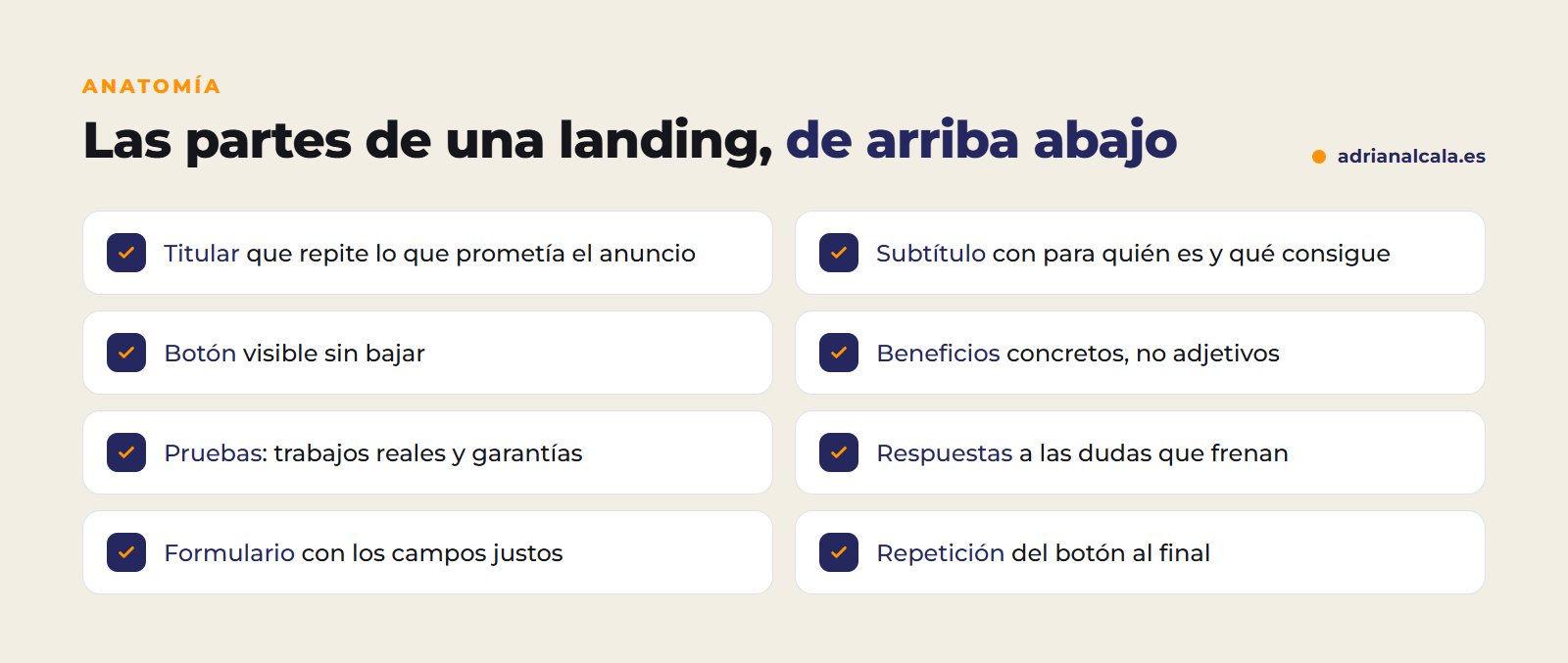
- A headline that repeats the ad's promise. Whoever arrives must confirm in a second that they are on the right site.
- A subtitle that specifies who it's for and what it achieves.
- A visible button without scrolling, for those who are already decided.
- Concrete benefits. «Receive your quote in 24 hours» says more than «quality service».
- Proof: real work, demonstrable data, guarantees.
- Answers to doubts that hinder the decision: price, deadlines, conditions.
- A form with just the right fields. Every extra field scares away submissions.
- The button again at the end, for those who have read everything.
An example: from the ad to the landing
Imagine a language academy advertising an intensive English course for the summer. This is how the ad and the page align:
| Element | What it says |
|---|---|
| Search | «intensive English summer course» |
| Ad | Intensive English course in July. Small groups. Reserve your spot. |
| Landing page headline | Intensive English course in July, in small groups |
| Button | Reserve my spot |
| Form | Name, email, phone, and approximate level |
| What is measured | Each reservation sent, attributed to its campaign and its ad |
Illustrative example: does not correspond to any client.
Make sure the person finds exactly what they were looking for and what the ad promised them on the page, with a single next step. There is no menu, no links to the blog, nor other courses to distract them.
Ad and page, the same message
Google and Meta measure the relationship between what the ad says and what the visitor finds. If they don't match, you don't just lose leads: the campaign can cost you more. Same headline, same offer, same tone.
How to know if your landing page works
A landing page is not judged by how pretty it is, but by what it achieves. To know this, you need two things:
If you're thinking of launching campaigns, review the following first Google Ads errors that eat up the most budget: sending clicks to the homepage is one of them.
Errores frecuentes on landing pages
- Leaving the website menu. Every outbound link is a paid click that can be lost.
- Talking about everything you do. One landing page, one offer.
- Long forms. Ask only for what you need for the next step.
- A slow page on mobile. Most ad traffic comes from mobile; if it's slow, they leave before seeing it.
- Not measuring. Without conversions, you decide where to invest blindly.

Adrián Alcalá Landing pages and campaigns
If you send paid traffic to your homepage, you're wasting clicks. The landing pages I know best are my own: they receive my own campaigns, with my money.
Frequently Asked Questions
Does a landing page rank on Google?
It can, but it's not usually its main goal. Landing pages are designed for campaigns; to appear on Google for a service, the usual is a service page with more content. The two can coexist without overlapping.
How much does a landing page cost?
It depends on what you need. In my case, an unautomated landing page is within the range of 500 to 2,000 €, and if it includes automation (for example, emails that are sent automatically after the form), in the range of 2,000 to 5,000 €.
Can I make the landing page on my own WordPress?
Yes. With WordPress and Elementor, the landing page stays on your website, under your name, and you can change texts and offers yourself for each campaign, without depending on a closed platform.
How many landing pages do I need?
One per offer or per campaign. If you advertise two different services, each should have its own, with its message and its form.
What is the difference between a landing page and a sales page?
A sales page is a type of landing page designed to sell directly, usually longer and with payment on the page itself. Other landing pages seek a previous step: a contact, a reservation, or a registration.
How much text should a landing page have?
The necessary to resolve doubts that hinder the decision. A simple and cheap offer is decided with little text; an expensive or unknown service needs more explanations, proofs, and answers before the form.
That every click has a destination
I do custom landing page design for your campaigns: one page, one goal, the measured form, and conversions connected to Google Ads and Meta.
To go deeper
Written by Adrián Alcalá
Web designer in Dénia. If you have any questions about what you have read, write to me.