

Antes de escribir una sola línea para posicionar tu web, hay una decisión que lo condiciona todo: por qué búsquedas quieres aparecer. Si eliges mal, puedes llegar a la primera posición por algo que nadie busca, o por algo que busca gente que nunca te va a comprar. Esta guía explica cómo elegir palabras clave paso a paso, con herramientas gratuitas y pensando en clientes, no en visitas de vanidad.
The essentials in 30 seconds
- Una buena palabra clave es la que usa tu cliente, no la que usas tú en el oficio.
- Detrás de cada búsqueda hay una intención: aprender, comparar, comprar o encontrar algo cerca.
- Prioriza las búsquedas que traen negocio, aunque tengan menos volumen.
- One page per keyword. If two pages compete for the same search, Google doesn't know which one to show.
In this article
- What is a keyword (and what not)
- The intent: what the searcher wants
- How to choose keywords in 6 steps
- A keyword map, with an example
- Short keywords or long-tail
- Free tools para empezar
- How to get keywords from Search Console
- Mistakes when choosing keywords
- Frequently Asked Questions
- ¿Quieres saber which searches to bet on?
What is a keyword (and what not)
A keyword is the search someone types into Google when they need something: "sports physiotherapist in Alicante," "how to remove humidity from a wall," "bathroom renovation quote." It's almost never a single word: it's usually a phrase.
Choosing keywords does not consist of repeating them many times in a text. It consists of deciding which search each page of your website will answer, and then building that page to be the best possible answer.
The intent: what the searcher wants
Two very similar searches can hide different intents. "What is SEO" is written by someone who wants to learn; "SEO company in Valencia," someone who wants to hire. Google knows this and shows different page types for each.
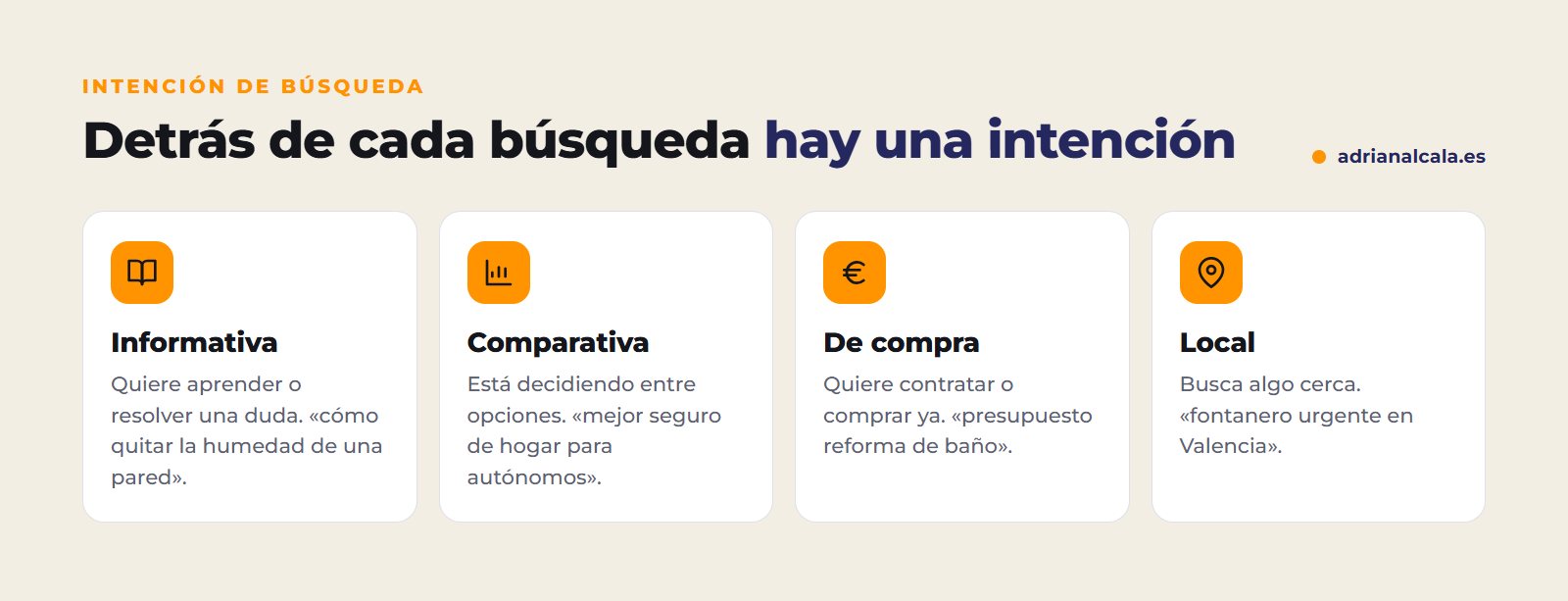
For a business, searches transactional and local are the ones that bring customers sooner. Informational ones serve to attract those who are still researching and, if well linked, end up leading to your service pages.
How to choose keywords in 6 steps
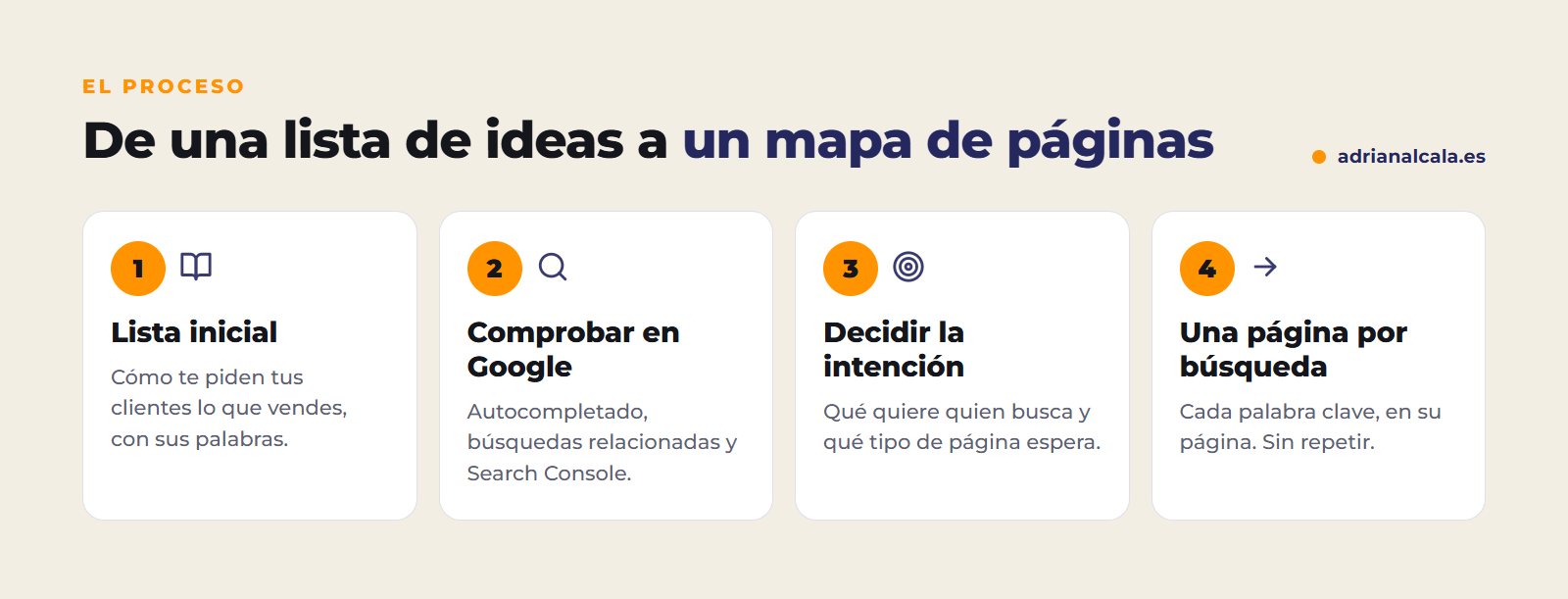
- Write down how they ask for what you sell. Review emails, calls, and customer messages. Write down their exact words, not the technical terms you use.
- Expand the list with Google. Type each idea into the search engine and look at the autocomplete, the "People also ask" block, and the related searches at the end.
- Look at what you already have in Search Console. In the Performance report, you'll see searches for which you already appear. Those with many impressions and few clicks are clear opportunities.
- Search each keyword and see what comes up. If Maps listings appear, the search is local. If articles appear, it's informational. If stores appear, it's transactional. Your page must be of the same type.
- Prioritize. First what brings business and you can win; then what has more volume or more competition.
- Assign a page to each keyword. Make a table with each page of your website and its main search. It's your keyword map.
A keyword map, with an example
This would be the map of an imaginary physiotherapy clinic. Notice that each page responds to a different search and none overlap with another:
| Page | Main keyword | Intent |
|---|---|---|
| Home | physiotherapy clinic in [city] | Local |
| Sports physiotherapy | sports physiotherapist in [city] | Local and transactional |
| Pelvic floor | pelvic floor physiotherapy in [city] | Local and transactional |
| Blog article | exercises for lower back pain | Informational |
| Blog article | how many physiotherapy sessions do I need | Informational |
Illustrative example: does not correspond to any client.
When two pages compete
If you have two pages that answer the same search, Google alternates between them or shows none in a good position. This is called cannibalization. It's fixed by combining the two into one or changing the focus of one of them.
Short keywords or long-tail
| Short | Long-tail | |
|---|---|---|
| Example | «physiotherapy» | «pelvic floor physiotherapy after childbirth» |
| Volumen | Mucho | Little for each one |
| Competition | Very high | Lower |
| Intent | Diffuse: you don't know what they want | Very clear |
| For whom | Websites with high authority | Almost any business, especially when starting |
Free tools para empezar
How to get keywords from Search Console
If your website is a few months old, Search Console is the most reliable source because it shows real searches, not estimates. This is how to leverage it:
- Open the Performance report and select the last three months.
- Activate the columns of impressions, clicks, CTR, and average position.
- Sort by impressions and look for queries where you appear often but in positions between 8 and 20: these are the easiest to improve.
- Click on each query and see which page appears. If two different pages appear for the same search, you have a case of cannibalization.
- Note down queries without their own page: questions or services that Google already associates with you and that deserve specific content.
Mistakes when choosing keywords
- Choosing by volume and not by business. Thousands of searches from people who won't buy from you don't pay bills.
- Using industry jargon. Your client doesn't search for «HVAC solutions,» they search for «install air conditioning.»
- Wanting to rank the homepage for everything. Each service needs its own page.
- Forgetting the area. If you work in a specific location, the city must be in the keyword and on the page.
If after choosing them your website still doesn't appear, check why your business doesn't appear on Google: sometimes the problem is not the keyword but something technical.

Adrián Alcalá SEO Positioning
Appearing first for a search nobody does is useless. The SEO that matters is the one that moves the phone and the inbox.
Frequently Asked Questions
How many keywords should each page have?
One main and several secondary ones that are variants or questions related to the same intent. If a page tries to rank for two searches with different intents, it usually doesn't win any.
Does search volume matter much?
It matters, but less than intent. A search with low volume and high purchase intent can bring you more clients than another highly searched but generic one.
How often should keywords be reviewed?
It's advisable to check Search Console every month: new searches appear for which you already rank and that deserve their own page or an improvement to an existing one.
Does this also work for appearing in ChatGPT or Gemini?
In large part, yes. AI assistants rely on content that is already well-positioned and clearly answers specific questions, which is exactly what you achieve with a good keyword map.
¿Quieres saber which searches to bet on?
I work on the SEO positioning for searches that bring business: keyword research, technical SEO, content, and authority, with a clear report of what is done and what it returns to you.
To go deeper
Written by Adrián Alcalá
Web designer in Dénia. If you have any questions about what you have read, write to me.