

More and more people don't search: they ask. They ask ChatGPT to recommend a consultancy in their city, they ask Gemini how much it costs to renovate a bathroom, or read the AI summary that Google puts above the results. From there, a new acronym has emerged, GEO, and a question we often receive: should we abandon SEO to do GEO? The short answer is no. This guide explains what SEO and GEO, how they differ, what they have in common, and what to do on your website to appear in both places.
The essentials in 30 seconds
- The SEO seeks for you to appear in Google and Bing results; the GEO, that AI assistants mention or cite you in their answers.
- They are not separate paths: assistants that search the internet rely on well-positioned and well-explained pages.
- For GEO, what matters most is the clarity, the concrete data and that your business appears the same everywhere.
- Nobody can guarantee you'll appear in ChatGPT. What you can do is make it easy for them.
In this article
What SEO is and what GEO
SEO (search engine positioning) is the work to make your website appear in Google or Bing results when someone searches for what you offer, and for that person to enter and contact you.
GEO comes from English Generative Engine Optimization: optimizing for engines that draft answers, such as ChatGPT, Gemini, Perplexity, Copilot, or Google's AI summaries. The goal is no longer just a spot on a list, but that the AI's answer mentions your business or cites your website as a source.
You will also see the acronym AEO (Answer Engine Optimization, optimize for answer engines). In practice, it is used almost as a synonym for GEO: writing so that a machine can extract a clear and correct answer from your page.
Differences between SEO and GEO
| SEO | GEO | |
|---|---|---|
| Where you appear | In the list of results and on the map | Within the answer drafted by the AI |
| What you pursue | A good position and that they click | That they mention you or cite you as a source |
| What is worked on | Complete pages, designed for a search | Snippets that answer a question on their own |
| What else helps | Technique, content, authority, and user experience | Clarity, concrete data, and a consistent online reputation |
| How it's measured | Impressions, clicks, and positions in Search Console | Visits coming from assistants and tests with your customers' questions |
Why GEO start with SEO
When an assistant needs current information (prices, schedules, who does what in an area), it searches the internet before answering. And what it finds comes, in large part, from pages that search engines already have indexed and well-rated.
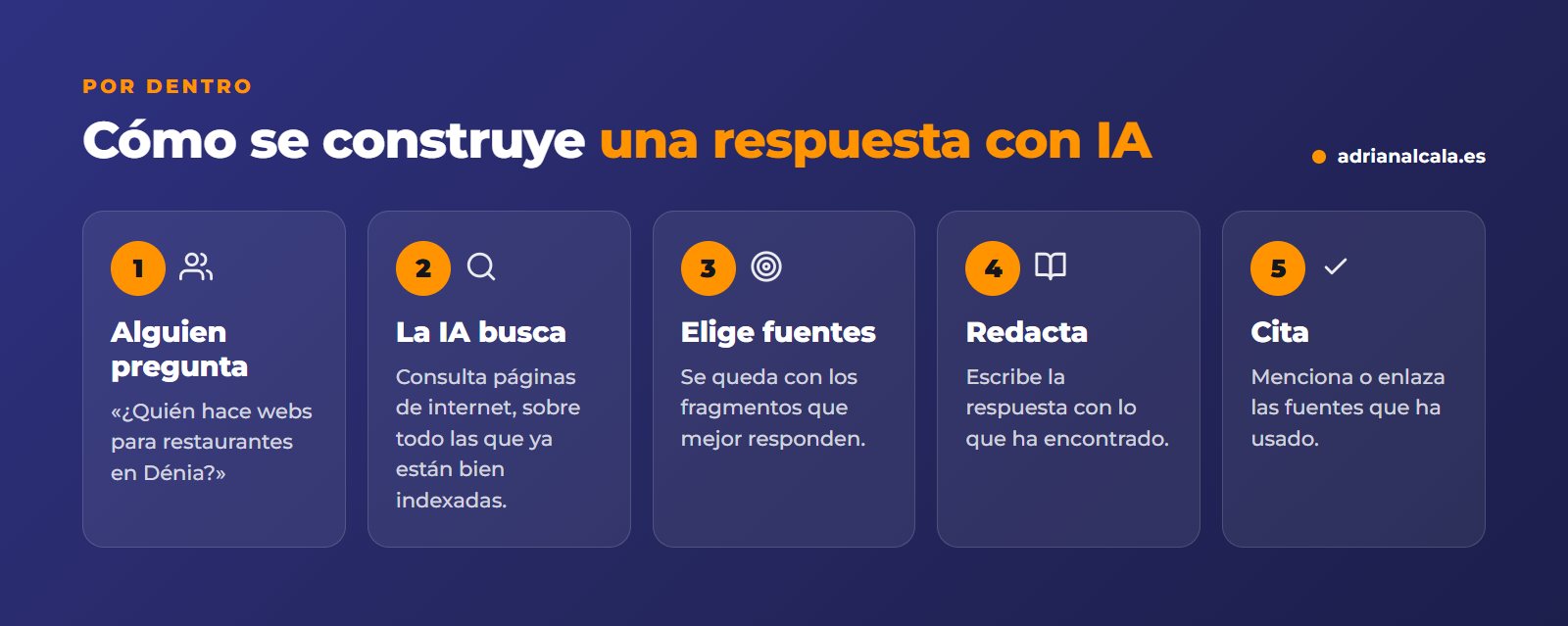
In Google's case, it's even more direct. Its own documentation explains it: to appear as a link in AI summaries, a page must be indexed and able to be displayed in search with its text snippet. There are no separate technical requirements or special tags. If your website is not well-positioned or well-explained, it's difficult for an AI to choose it to cite it.
That's why GEO doesn't replace SEO: it expands it. What changes is the way of writing and presenting information, so that a machine can extract an answer from your page without misunderstanding you.
What to do on your website for AI to cite you
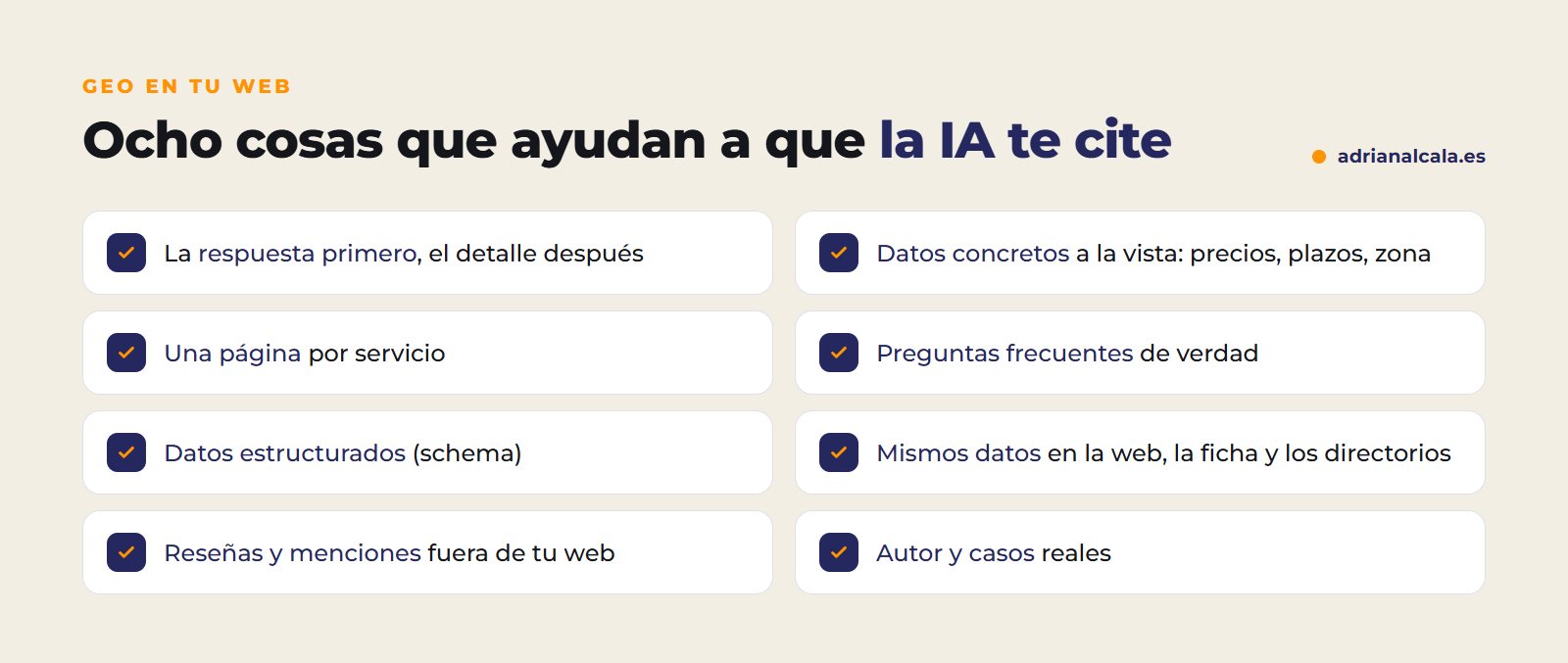
Check that you are not blocking assistants
Some firewalls and security plugins block unknown crawlers by default. If you want assistants to cite you, check that your file robots.txt and your firewall doesn't close the door to crawlers like OAI-SearchBot (ChatGPT's search crawler) or PerplexityBot. For Google, nothing special is needed: its AI summaries use the same crawler as normal search.
How to know if AI mentions you
There isn't one tool that tells everything here, so what can be measured is combined:
- Visits coming from assistants. In Google Analytics, look at visits originating from chatgpt.com, perplexity.ai, gemini.google.com, or copilot.microsoft.com, and which pages they land on.
- Tests with your clients' questions. Once a month, ask several assistants the questions your clients would ask you («who makes websites for restaurants in Dénia?», «how much does it cost…?») and note if you appear, with what data, and what source they cite. Answers change depending on who asks and when, so look at the trend, not a single answer.
- Ask whoever contacts you. Add «An AI (ChatGPT, Gemini…)» as an option in the «How did you hear about us?» section of your forms.

Adrián Alcalá Web, SEO, and AI
AI search engines rely on websites that are already well-positioned and well-explained. A clear, fast, and good content website has more chances of appearing in their responses.
Errors when working GEO
- Treating it as a separate trick. There's no magic tag to appear in ChatGPT: it's clear content on a well-made website.
- Writing for machines. Repeating keywords or filling the page with empty questions worsens readability, for people and for AI.
- Generic content. If your page says the same as a hundred others, AI has no reason to cite you. Provide what only you know: prices, deadlines, cases, and how you work.
- Promising results. Nobody controls what an assistant responds. Distrust anyone who guarantees you'll appear in ChatGPT.
- Forgetting the Google Business Profile. In local searches, your business profile and reviews are among the first things consulted. Keep it complete and up to date.
Frequently Asked Questions
Does GEO replace SEO?
No. GEO relies on SEO: assistants primarily cite pages that search engines already find and value. What GEO adds is a way of writing and organizing information so that a machine understands it without errors.
Do I have to make a different website for AI?
No. It's the same website, better explained: direct answers, specific data, one page per service, and business data consistent everywhere. What helps AI also helps your customers.
Is GEO useful for a local business?
Yes. Many people already ask for recommendations like «recommend me a physiotherapist in Dénia». To appear in those answers, a complete Google Business Profile, reviews, a page per service and area, and your name, address, and phone number matching everywhere count.
How long does it take to be noticed?
It goes at the pace of SEO: first, search engines have to find and understand your pages. Very specific questions, with few good answers on the internet, tend to move faster than general ones.
Do I need an llms.txt file?
It's not essential. It's a proposal to offer AI models a plain text summary of your website, and Google doesn't use it in its search engine. Before that, it's advisable to have the basics right: clear pages, consistent data, and a website that indexes without problems.
Do Google find you and AI?
In half an hour, we'll look with you at how Google and AI assistants see you when someone searches for what you sell, and we'll tell you what to change first. Free and without obligation. We work on it within our SEO positioning, which also covers YouTube, Bing, and AI search engines.
To go deeper
Written by Adrián Alcalá
Web designer in Dénia. If you have any questions about what you have read, write to me.